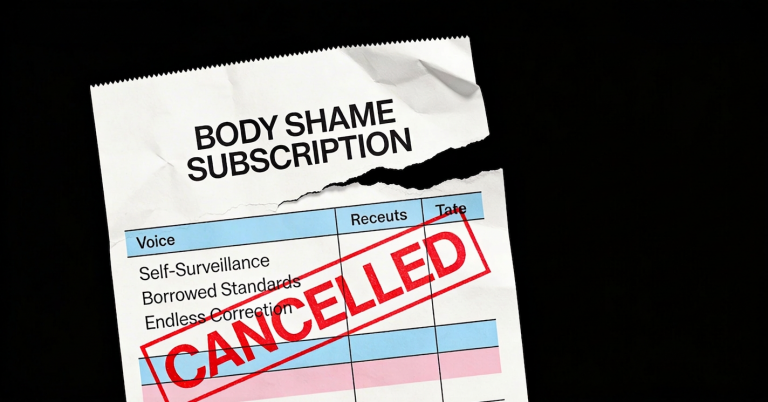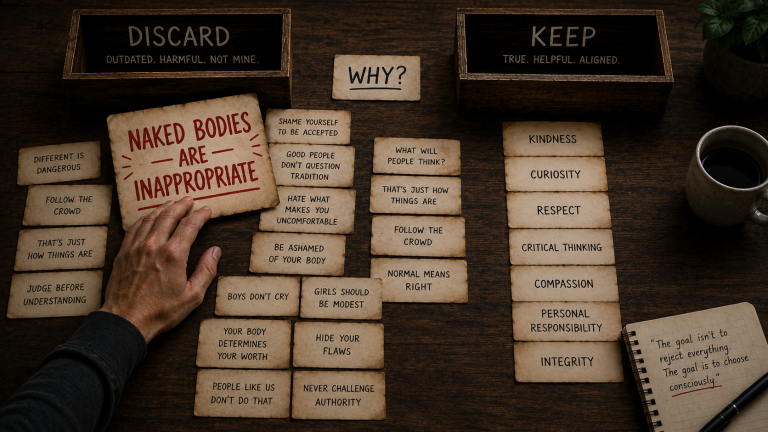
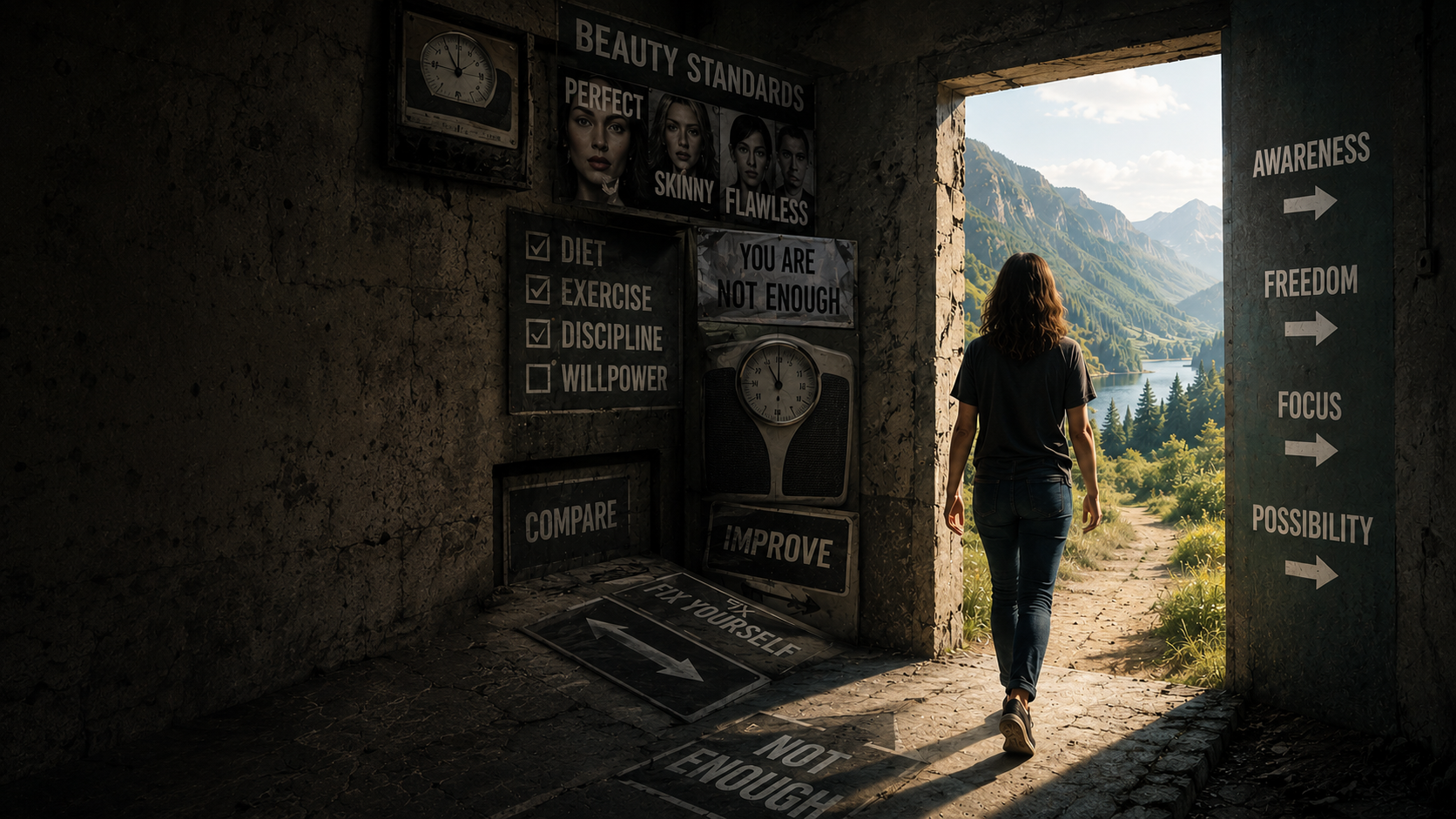
Why “Fixing Your Body Image” Doesn’t Work
You are not failing the process. The process was designed to keep you in it.
Let’s be direct about something the self-improvement industry does not want you to notice: most of the tools designed to fix your body image were built inside the same system that created the problem.
That is not a coincidence.
The Renovation Problem
When someone tells you to “work on your body image,” the implied instruction is to take the existing framework, the one that ranks bodies, assigns value to appearance, and treats your reflection like a report card, and feel better inside of it.
Not question it.
Not dismantle it.
Not replace it.
Just renovate it.
Do affirmations until the criticism feels quieter. Build confidence until the standard stings less. Practice self-acceptance until you can tolerate the measurement.
But the measurement is still running.
That is the trap.
Fixing your body image inside the existing system is like repainting a house with a bad foundation. It looks better for a while. Then the cracks come back. And you blame yourself for not painting carefully enough.
Why the Results Don’t Last
Body image work often feels temporary because it treats a structural problem like a personal one.
You do the affirmations. You feel better for a week. Then a comment, a photo, a fitting room, a number on a scale, an ad, or an offhand remark resets everything.
It feels like failure. So you double down.
That cycle is not proof that something is wrong with you. It is proof that the framework is still intact. The standard is still operating. You are just getting better at managing your reaction to it.
Acceptance without understanding is not freedom. It is coping.
And coping has its place. But it isn’t resolution.
What “Acceptance” Usually Means
In most self-help contexts, acceptance has been softened into something else entirely.
It often means learning to tolerate yourself while still measuring against the same standard.
That is not acceptance. That is learning to live with the judgment instead of questioning it.
Real acceptance removes the case against you altogether. It is not “I accept my body even though it is flawed.” It is “I question the framework that decided it was flawed in the first place.”
Those are very different positions.
One keeps the system in place and asks for relief inside it.
The other starts examining whether the system deserves authority at all.
Understanding Changes the Equation
This is where understanding does what affirmations cannot.
Beauty standards are not fixed. They are shaped, reinforced, and constantly shifting. A moving target is never reached, and people who are still chasing tend to keep spending.
Once you start to see that pattern, the standard stops feeling like objective truth. It starts feeling less like fact and more like a story that profits from being believed.
Understanding does not erase every conditioned response. But it changes the weight those responses carry. It becomes harder to fully believe in a standard once you see how it operates and who it serves.
Affirmations require constant repetition.
Understanding tends to stick.
Why Most Solutions Feel Temporary
They feel temporary because they address the symptom while leaving the source untouched.
The environment stays the same. The messaging stays the same. The incentives stay the same.
So the pressure keeps returning.
This isn’t pessimism. It’s just looking at how the system actually works.
If something keeps reappearing, it is worth asking what keeps it in place.
What Actually Moves the Needle
Not more effort inside the same framework.
The shift starts with questioning the framework itself.
Who decided what a “good” body looks like?
Why is the solution almost always directed inward?
Who benefits from you staying focused on your appearance?
What would your attention move toward if it was not tied up here?
Body shame is not just emotional. It is expensive in attention, time, and energy. It occupies space that could be used for something else entirely.
Once you start to see that, the goal changes.
Not to fix yourself.
Not to renovate the system.
To step outside of it and stop playing by its rules.
If this shifted something you’ve been carrying, keep going.
Free essays every Tuesday.
Deeper work on Fridays.
Subscribe to stay in it.