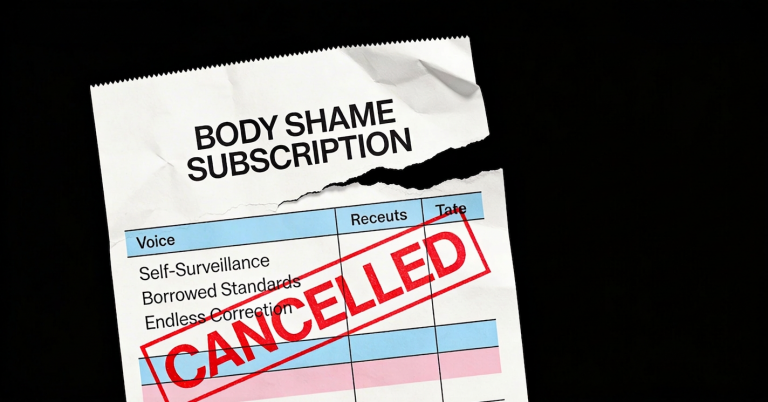
Your Social Programming Isn't Yours
You think you are making your own choices. You aren’t. Here is how to spot the invisible scripts running your life.
Most people are running software they never chose and have never once audited.
Watch a room full of people for ten minutes. Really watch. Count the micro-adjustments—the shirt tugged down, the posture corrected the moment someone looks over, the laugh slightly too loud, the opinion slightly too soft. The constant, low-grade performance of being acceptable. Nobody told them to do this today. No one is holding a gun to their head. They just do it, automatically, because the program runs in the background and they have never had a reason to notice it.
I noticed it. I noticed it because I was never running the same program.
My Wiring Is Not the Story. It Is the Lens.
I have ADHD and Tourette’s. I am not telling you this for your sympathy, and I am not building a medical diary. I am telling you this because it is the only honest explanation for why I can see what most people cannot.
Here is what those conditions share: they both made performing “normal” a conscious, effortful, manual process. Where most people absorb social rules the way they absorb language—passively, through immersion, without ever having to think about the grammar—I had to learn the rules like a foreign language in a classroom. Rule by rule. Exception by exception. With constant feedback that I was conjugating something wrong.
That is not a tragedy. That is a contractor’s education.
I grew up on job sites with my father, a general contractor. I know how to look at a structure. When you have to manually decode a social system to survive inside it, you look at it the same way: you look for the blueprint. You see the load-bearing walls. You see which rules are structural and which ones are just ugly wallpaper someone hung forty years ago and called tradition.
I spent 52 years standing slightly outside the room, watching through the glass, taking notes. Not because I wanted to be an outsider. Because my wiring gave me no other choice. And at some point, I stopped seeing that as a deficit and started seeing it as the only vantage point worth having.
The Mask You Don’t Know You’re Wearing
Here is where it gets interesting—and uncomfortable.
The neurodivergent community has a term: masking. It means suppressing your natural behaviors, reflexes, and responses to pass as neurotypical. It is exhausting. It is corrosive. And at some point, for most of us, it becomes unsustainable. The mask has a cost, and eventually the bill comes due.
I unmasked because I had to. My nervous system demanded it.
But here is the question I keep turning over: Why are you still masked?
Not neurologically. Physically. Socially. Behaviorally.
Why are you wearing clothes that cause you discomfort because some inherited rule said your body is a problem to be managed? Why are you performing modesty you do not actually feel because someone, somewhere, decided that your comfort was less important than a stranger’s ease? Why are you shrinking your body language, apologizing for your physicality, and engineering your appearance around a standard you never agreed to and never examined?
You are not neurodivergent. You have no external force demanding the mask. You are just wearing it anyway—out of habit, out of fear, out of a conditioning so deep it has started to feel like your own preference.
It is not your preference. It is your programming.
What “Physical Unmasking” Actually Means
NKD by Design is not about nudity as a lifestyle statement. It is not shock value. It is not a rejection of all clothing on principle.
It is about applying the same forensic scrutiny to your physical existence that I was forced to apply to my social one.
Every rule you follow about your body—what to cover, what to hide, what to minimize, what to be ashamed of—has an origin. Most of those origins have nothing to do with your actual comfort, your actual values, or your actual life. They are inherited code. Passed down from people who were also running inherited code, who got it from people before them, stretching back through generations of unexamined assumption.
The question NKD by Design asks is simple and genuinely difficult: Which of these rules did you actually choose?
Not which ones feel familiar. Not which ones keep the room comfortable. Not which ones you have followed for so long they feel like instinct. Which ones did you look at, examine, test against your own experience, and consciously decide to keep?
If you cannot answer that—if the honest answer is “none of them, I’ve never thought about it”—then you are not living in your body. You are managing it. On behalf of other people’s comfort.
The Mechanical Lens
The reason I can write about this—the reason I can point at these systems and describe their architecture with any precision—is because I had no choice but to see them.
My ADHD means my brain doesn’t filter stimuli the way yours does. I see the micro-calculations people run before they speak, before they move, before they take up space. I see them because they register as noise in a way they don’t for most people. My Tourette’s meant spending years watching my own body betray social scripts in real time, and watching the room recalibrate around the disruption—learning, involuntarily, exactly how rigid those scripts actually are.
The sum of those experiences is this: I see the machine. I see the gears. I can show you where the conditioning is load-bearing and where it is just friction you are carrying for no structural reason.
That is the specific and not-replicable thing this brand offers. Not philosophy. Not self-help frameworks. Not a six-step process for “finding your authentic self.” A mechanical, outsider analysis of the rules you are following and the cost you are paying to follow them.
What This Is Not
This is not an invitation to perform liberation. There is already too much of that—people who talk endlessly about “living authentically” while carefully managing their aesthetic at every angle. That is just masking with better branding.
This is not trauma content. My conditions are not the story. They are the instrument. The story is what the instrument allows me to see.
And this is not comfort. If you read this and feel slightly accused, that is intentional. The first step in auditing your conditioning is noticing that you have some. That moment of resistance—“but I genuinely like the way I dress”—is interesting. Examine it. Where did “genuine” come from? How old were you when you decided? Who was in the room?
I am not here to give you answers. I am here to make the questions unavoidable.
The System Running You
You did not choose the rules your body lives under. You inherited them, absorbed them, and eventually stopped noticing you were following them at all. That is not weakness. That is how conditioning works—it becomes invisible precisely when it has finished installing.
NKD by Design exists because invisible systems still have costs. Because the energy you spend performing acceptable takes from somewhere else. Because the discomfort you have normalized is still discomfort. Because the blueprint exists, and once you have seen it, the wallpaper stops looking like architecture.
I can see the blueprint. I have been reading it my whole life.
The question is whether you want to look at it too.
If this shifted something you’ve been carrying, keep going.
Free essays every Tuesday.
Deeper work on Fridays.
Subscribe to stay in it.