
You Don’t Have a Body Image Problem
How multi-billion-dollar industry built a standard, sold you the cure, and blamed you for the damage.

Let’s get something out of the way: you don’t have a body image problem.
The mirror isn’t broken. Your perception isn’t faulty. You’re not damaged, delusional, or uniquely fragile. What you have is a rational response to an irrational system, and we’ve been calling it a personal failing for decades.
That’s a very convenient mistake. For someone.
The Problem Was Built, Not Born
Nobody comes out of the womb hating their stomach. Babies don’t lose sleep over their thighs. Children don’t spontaneously decide that soft is bad, round is wrong, or aging is shameful.
That story gets installed.
Through magazines, movies, family comments, locker room ridicule, beauty marketing, and fitness culture that often disguises punishment as discipline. Through repetition. Through reward. Through humiliation. Through the quiet message, delivered over and over, that some bodies are acceptable and others are explanations waiting to happen.
Self-perception isn’t random. It’s shaped, repeatedly and profitably.
And that last part matters.
An industry built on your confidence makes very little. An industry built on your doubt makes billions. Beauty, dieting, wellness, anti-aging, body sculpting, “clean living,” transformation culture, all of it depends on one thing: keeping you slightly dissatisfied.
They do not sell resolution. They sell maintenance. They sell the problem on a subscription model.
If you ever felt fully at home in your body, whole sections of the economy would lose a customer.
The Blame Redirect
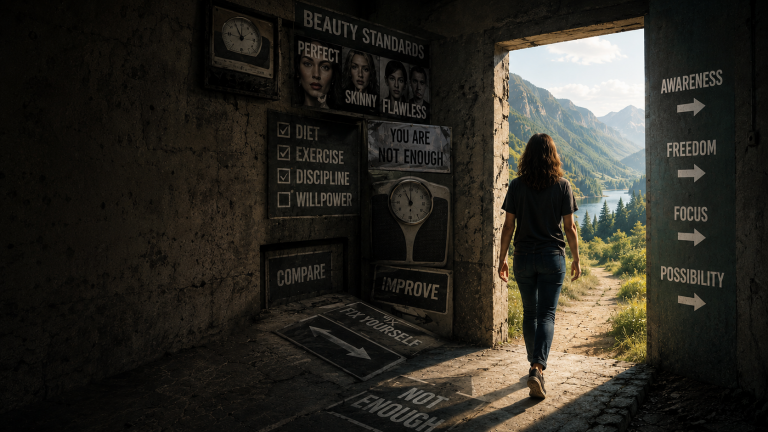
Here’s the trick that keeps the whole machine running: create the standard, flood people with it, then blame them for failing to meet it.
You were exposed to altered images, narrow ideals, and social penalties long before you had the ability to question any of it. And the ideal never stayed still. Thin, then toned. Curvy, but only in the approved places. Youthful, but effortless. Natural, but improved. The target moved constantly because a moving target keeps people chasing.
And chasing people spend money.
Then came the second insult: once the damage was done, it was handed back to you as a personal issue. Your insecurity. Your self-esteem problem. Your mindset. Your healing journey. Your responsibility to fix.
Therapy. Affirmations. Diets. New routines. Better discipline. Better habits. A better body.
We handed people the bill for damage the culture worked very hard to create.
“Just Be Confident” Is Not a Solution
Even a lot of self-love messaging falls into the same trap.
It means well, but it still places the burden on the individual. Just love yourself. Just choose confidence. Just decide to stop caring. As if self-perception exists outside culture. As if people can override years of conditioning through positive thinking and better captions.
Telling someone to “just be confident” while leaving the system intact is like handing them a mop while the pipe is still bursting.
It feels helpful. It changes nothing.
Confidence is not just a mindset. It is also a condition. People tend to feel better in environments where they are not constantly being measured, ranked, corrected, sexualized, or told they need to earn the right to take up space.
A lot of what gets called “natural confidence” is just the absence of relentless erosion.
What Questioning Actually Looks Like
This is not an argument against health. It is an argument against inherited standards pretending to be truth.
Ask better questions.
Who decided what a “good” body looks like?
When did that standard appear?
Who benefits from it?
Who gets punished by it?
What gets labeled as discipline when it’s really fear?
What gets labeled as self-improvement when it’s really compliance?
Does the rule that visible fat equals failure make sense, or has it just been repeated often enough to feel true? Does the idea that aging makes a body lesser reflect biology, or branding? Does the belief that you owe the world attractiveness before you’re allowed comfort, visibility, intimacy, or peace come from reason, or repetition?
Repetition creates normal.
Normal becomes invisible.
Invisible becomes unquestioned.
And what goes unquestioned starts to feel like truth.
You were handed a story about your body before you were old enough to consent to it.
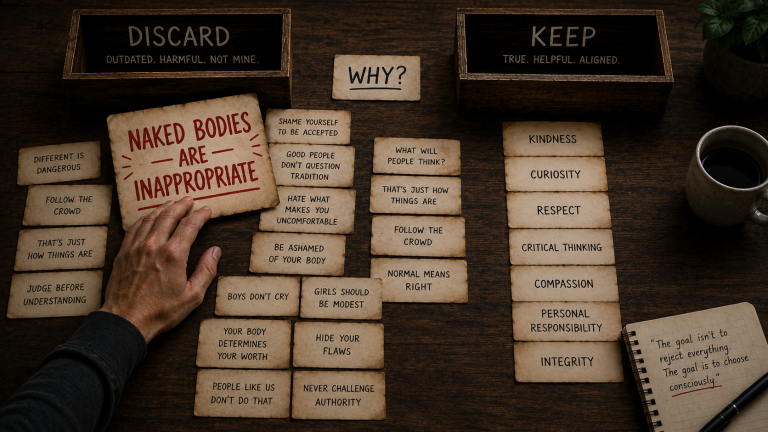
The work is not to love yourself on command. The work is to notice the script, trace where it came from, and decide whether it deserves any authority over you at all.
You don’t have a body image problem.
You have a clear picture of what you were trained to see.